We Are Not Done Yet! Everything You Need to Know About Java4Shell RCE
Breakdown of Java4Shell (CVE-2026-114938): how the OpenJDK Base64 RCE exploit works, affected enterprise apps, vulnerable versions, and immediate fixes.
A pre-authentication heap overflow in OpenJDK's hardware-accelerated Base64 decoder puts modern enterprise workloads squarely in the crosshairs.
Just when your security team finally finished cleaning up the last five years of Log4Shell stragglers, Java decided it missed the spotlight. Meet Java4Shell (CVE-2026-114938), a fresh, pre-authentication Remote Code Execution (RCE) vulnerability baked straight into the standard Base64 decoder of OpenJDK.
Because Java’s longtime motto is "Write once, run anywhere," security researcher Quang Luong at Calif.io fittingly dubbed this latest nightmare "Write once, RCE everywhere."
The Issue and the Risk
At its core, CVE-2026-114938 is a heap-based buffer overflow (CWE-122) living inside the standard Java Base64 library. For decades, developers were told that Java is a memory-safe language that shields applications from C-style memory corruption. Yet, in the endless pursuit of making enterprise bloatware run three nanoseconds faster, OpenJDK uses low-level CPU hardware intrinsics to accelerate Base64 decoding. That performance shortcut contains a critical memory corruption bug.
Oracle tried to play it cool by assigning a CVSS 3.1 score of 8.1 ("High" complexity), while the researchers at Calif slapped it with a much more realistic CVSS 4.0 score of 9.2 (Critical).
The risk is simple and severe. Any unauthenticated attacker who can feed a malformed Base64 string to your application can achieve one of two outcomes without ever logging in:
-
JavaBleed (Memory Disclosure): Attackers can read sensitive application memory out of bounds, exposing cryptographic keys, plaintext passwords, environment variables, and active session tokens.
-
Java4Shell (Remote Code Execution): Attackers can overwrite adjacent heap memory to hijack control flow and execute arbitrary code on the host.
How the Exploit Works
Base64 is the duct tape of the internet. It is processed before authentication even finishes, handling Basic Auth headers, JSON Web Tokens (JWTs), SAML assertions, API payloads, and file uploads. When an affected Java Virtual Machine (JVM) runs on a modern processor supporting AVX-512 VBMI instructions, it offloads Base64 decoding to a specialized hardware-accelerated routine.
By sending a single, carefully crafted malformed Base64 payload to any endpoint that decodes untrusted input, an attacker triggers an out-of-bounds write on the JVM heap.
While an RCE payload is not a universal "one-size-fits-all" script, since attackers have to tailor the heap corruption to the specific target application, the barrier to entry remains dangerously low. A single HTTP request carrying a poisoned JWT or Basic Auth header is all it takes to pop a shell or leak memory.
Applications in the Blast Radius
If an application runs on a modern JDK and touches Base64 before completing authentication, it is likely exposed. Security researchers have already demonstrated or confirmed pre-authentication exposure in default configurations across major enterprise staples:
-
Identity and Access Management: Keycloak and PingFederate.
-
DevOps and CI/CD Pipelines: Jenkins, JFrog Artifactory, Gerrit, and Netflix Spinnaker.
-
Enterprise Collaboration and Search: Atlassian Jira, Atlassian Confluence, Elasticsearch, and Apache Solr.
-
Core Frameworks and Message Brokers: Spring Boot, Apache Tomcat (including Basic Auth), Apache Struts, Apache Kafka Broker, and ubiquitous libraries like
java-jwt.
Compromised Systems, Hardware, and Patched Versions
Here is the one silver lining for procrastinators: if you are still running legacy Java 8 or Java 11 (outside of Oracle's special Enterprise Performance Pack), your technical debt just saved you. Standard Java 8 and 11 builds are not affected. Look at that: procrastination finally paid off. Similarly, if your workloads run on ARM64 architectures (such as AWS Graviton or Apple Silicon), you are completely immune.
An environment is only compromised if it meets both of the following conditions:
-
Vulnerable Hardware: Workloads running on x86-64 processors with AVX-512 VBMI support (Intel Xeon Ice Lake, Sapphire Rapids, Emerald Rapids, Granite Rapids, or AMD EPYC and Ryzen Zen 4 and newer).
-
Vulnerable Runtime: Applications running OpenJDK 17.0.6 or newer across the Java 17, 21, 25, or 27 release lines. This affects every major downstream distribution, including Oracle Java SE, Oracle OpenJDK, Oracle GraalVM, Amazon Corretto, Eclipse Temurin, Microsoft Build of OpenJDK, Azul Zulu, BellSoft Liberica, SAP SapMachine, and Red Hat OpenJDK.
The table below outlines the affected Oracle and OpenJDK version lines alongside their patched releases:
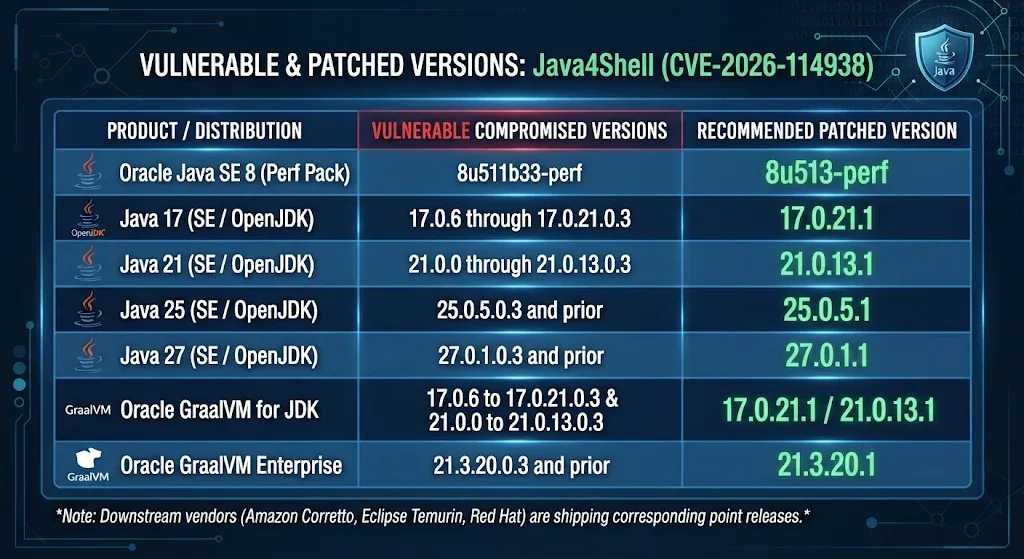 Note: Downstream vendors like Amazon Corretto, Eclipse Temurin, and Red Hat are shipping corresponding point releases matching the OpenJDK fixes above.
The Business Impact
This is not a vulnerability where engineers can simply patch a single pom.xml dependency and call it a Friday. Because the flaw sits inside the Java runtime itself, updating the operating system's default Java package will not touch the dozens of Docker containers, Kubernetes pods, and third-party appliances that bundle their own isolated JDKs.
Worse still, because Base64 is processed right at the front door of authentication (SSO portals like Keycloak, API gateways, and Tomcat servers), a single unpatched internet-facing server running on modern cloud instances gives attackers a straight shot at crown-jewel credentials via JavaBleed or full server takeover via RCE.
Recommendations: How to Stop the Bleeding
Security and infrastructure teams should prioritize the following remediation steps immediately:
-
Check Your Silicon First: Before panicking, verify whether your x86-64 hosts actually support AVX-512 VBMI. On Linux, run
lscpu | grep avx512to see if your CPUs even expose the vulnerable instruction set to the OS or guest virtual machines. -
Hunt Down Bundled JVMs: Audit every running JVM across your fleet. Pay special attention to container base images and self-contained vendor appliances (such as Jira, Jenkins, and Artifactory) that pack their own embedded JDKs.
-
Patch and Restart: Upgrade immediately to the fixed builds (17.0.21.1, 21.0.13.1, 25.0.5.1, or 27.0.1.1) and restart every running JVM service so the patched runtime actually loads into memory.
-
Apply JVM Flags as an Immediate Workaround: If you cannot patch right away, disable the broken hardware shortcut by passing
-XX:-UseBASE64Intrinsics(or-XX:UseAVX=2to disable AVX-512 entirely) to your JVM startup arguments and restarting the service. -
Isolate and Monitor: Deploy strict Web Application Firewall (WAF) rules in front of internet-facing Java applications to filter malformed Base64 payloads, and scrutinize authentication and crash logs for unexpected JVM segmentation faults or heap corruption anomalies.
Get the Intelligence Brief
Breaches, CVEs and IAM news in one email, as often as you choose.
By subscribing you agree to receive email from Paulo Barrilli, publisher of Identity at the Core. You can withdraw consent at any time with the unsubscribe link in every email, or by writing to contact@identityatcore.org.
Be the first to comment
Members only: sign up if you have something worth saying.
Want to weigh in? Sign in or create a free account.
No comments yet.